
The Framework of a Successful Home
Framing is where a house becomes a home. It’s the transformation from lines on a blueprint to walls, rooms, and rooflines you can walk through. For homeowners, understanding the framing phase removes a lot of mystery and anxiety; for builders, a reliable turnkey framing partner is the difference between a predictable schedule and costly delays. In this guide, we’ll walk through the complete home framing process – from the first layout line snapped on the foundation to the last sheet of roof sheathing – and show how a turnkey approach keeps everything coordinated, code-compliant, and on budget.
What “Turnkey Framing” Really Means
In residential construction, “turnkey” describes a service that’s planned, managed, and delivered by one accountable team. A turnkey framing company coordinates design details with the architect and engineer, performs structural takeoffs, procures materials, schedules crews and cranes, handles in-field adjustments, and prepares the structure for mechanicals and inspections. Instead of juggling multiple crews and suppliers, you work with a single partner that has the tools, talent, and workflow to bring the structure together efficiently. The result: fewer delays, clearer communication, better safety, and stronger quality control.
Preconstruction: Layout, Plans, and Materials
Great framing starts before anyone touches a stud. Preconstruction includes:
• Plan Review and Value Engineering: We confirm dimensions, load paths, shear walls, and nailing schedules; we also look for opportunities to simplify without compromising strength – like using engineered headers or altering stud spacing where allowed by code.
• Material Takeoff and Procurement: Accurate counts for studs, plates, joists, trusses, sheathing, fasteners, connectors, and weather barriers. Reliable supplier relationships reduce lead-time surprises.
• Jobsite Readiness: We check the foundation for level, square, and anchor bolt layout. Any foundation discrepancies are addressed now, not after walls are raised.
• Schedule Coordination: We align framing start with foundation cure time, site access, crane availability (for trusses/panels).
Step-by-Step Best Practices: The Framing Process
1) Foundation Verification and Sill Plates
We verify dimensions, diagonals, and anchor locations. Then we install pressure-treated sill plates with proper washers and nuts. A continuous sill seal helps air-seal the home and minimize squeaks. Getting this right ensures the whole structure sits square and true.
2) Floor System
For crawlspace or basement builds, floor framing comes next. Beams, girders, and rim joists are set first, followed by floor joists or I-joists. We install blocking/bridging per manufacturer specs to control deflection and vibration. Subfloor sheathing is glued and fastened with correct spacing and fastener schedules, creating a flat, squeak-free platform for walls.
3) Exterior Walls
We frame exterior walls on the deck for speed and accuracy. Each wall includes bottom and top plates, studs, headers, jacks, and cripples as required. Openings for windows and doors match the plan’s rough openings. We pay special attention to corners and intersections so sheathing and siding install smoothly later.
4) Interior Walls
Interior partitions define rooms and circulation. We frame bearing walls to transfer loads to the foundation. When asked for in advance, we provide proper blocking for towel bars, cabinets, and handrails now prevents patchwork reinforcement later.
5) Shear Walls and Lateral Systems
Modern codes require engineered shear walls and hold-downs in high-wind or seismic regions. We follow the shear schedule to the letter: correct panel thickness, edge spacing, nailing patterns, and hardware (straps, anchors, and tension ties). These details are vital to resist racking forces and keep occupants safe.
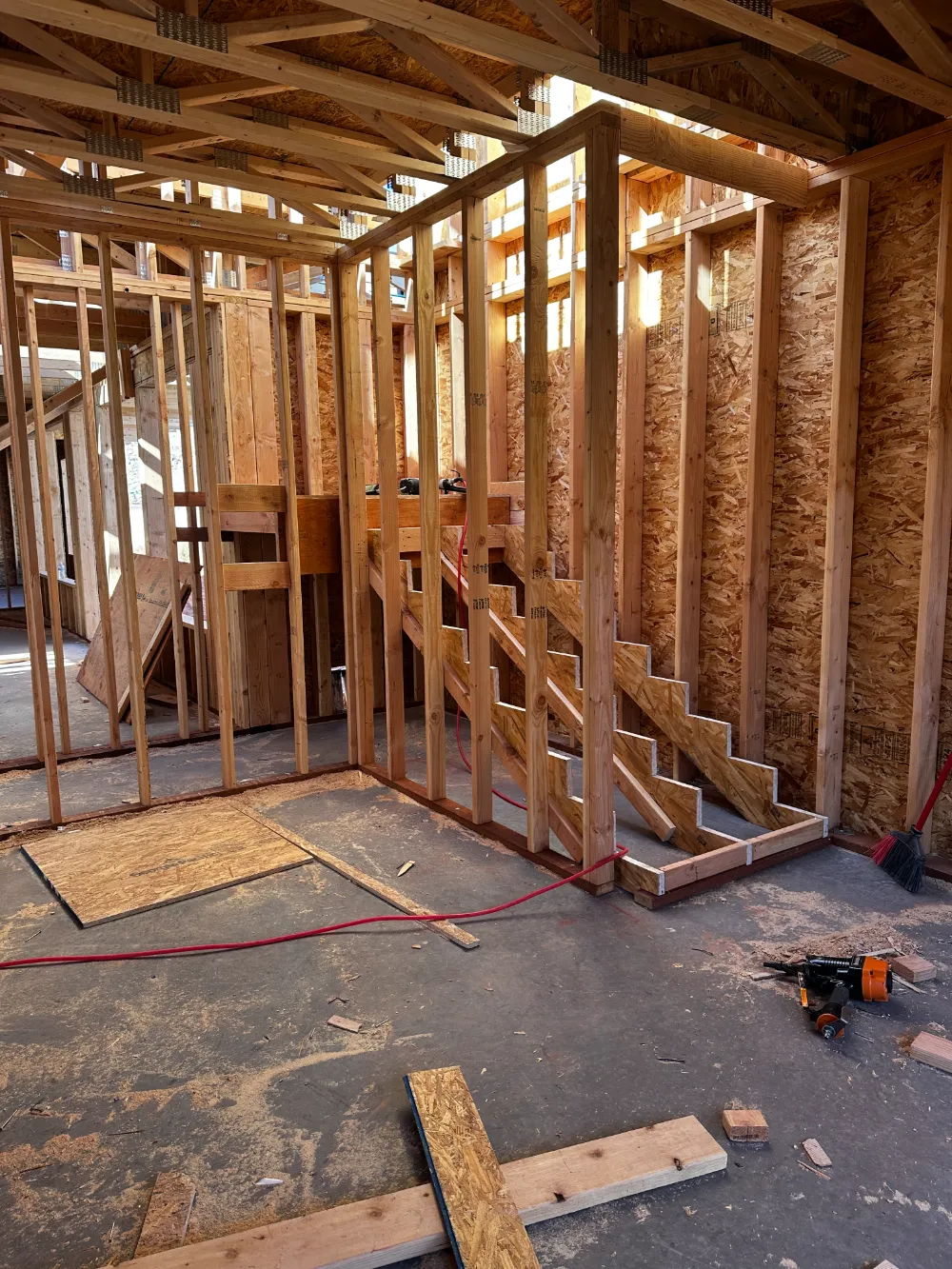
6) Second Floor and Stairs (if applicable)
For two-story homes, we repeat the floor system process, ensuring stair openings, bearing points, and mechanical penetrations are framed precisely. Temporary guardrails provide jobsite safety during this phase.
7) Roof Framing
Depending on the plan, we install prefabricated trusses or stick-frame rafters/ridge beams. Trusses create predictable spans and speed; stick framing allows custom geometry. We verify heel heights, birdsmouth cuts, and rafter ties; add lookouts for gable overhangs; and frame valleys/hips to plan. Proper roof venting paths (soffit to ridge) are protected with baffles.
8) Roof and Wall Sheathing
Wall and roof sheathing add rigidity and form a nailable base for exterior finishes. We stagger joints, maintain expansion gaps, and fasten per code. This step readies the home for roofing felt/synthetic underlayment and housewrap.
9) Framing Inspection and Punch
Before mechanical trades arrive, we perform a rigorous internal QA check: stud alignment, square openings, correct header sizes, properly installed hangers and straps, fire blocking/draft stopping, and code-required stair geometry. We meet with the inspector, address any notes, and deliver a jobsite ready for MEP rough-ins.
Quality and Safety: Non-Negotiables
• Materials: We cull twisted or checked boards to keep walls straight.
• Fasteners and Connectors: We use industry standard nails, screws, and hangers – no substitutions that weaken load paths.
• Jobsite Safety: We prioritize safety of our crew and others at all times.
How Turnkey Framing Saves Time and Money
Turnkey teams reduce handoffs. That means fewer scope gaps, fewer change orders, and less downtime waiting for materials or answers. Our centralized coordination keeps everyone on the same page, from the supplier’s delivery schedule to the actual build. Most importantly, one warranty and one point of accountability streamline every decision.
Frequently Asked Questions
Q: How long does framing typically take?
A: A straightforward single-family home often frames in 1–3 weeks depending on size, weather, crew size, and complexity. Multi-story custom homes may take 4–6 weeks or more.
Q: Do you provide materials or just labor?
A: As a turnkey partner, we handle takeoff, procurement, delivery coordination, and installation – one integrated service with tight cost control.
Q: What should be complete before you start?
A: Foundation should be cured and verified, utilities located, site access cleared for deliveries and plans approved.